


Enhancing search features in an existing app to elevate the user experience.
Anyone looking to travel: Families, Business Travelers, Groups of Friends, Couples, Individuals
THE CLIENTS
Adding features to the travel website, Vrbo (Vacation Rentals By Owner)
THE PRODUCT
UX/UI Design, Market Research, Competitor Analysis, Participant Recruitment, User Interviews, Affinity Map, Project Goals, Problem Statements, Feature Set, Persona Development, Site Map, User Flow, Wireframing, Prototyping, User Testing, Iterations, UI Library Kit
MY ROLE
Figma, Figjam, Google Meet, Similar Web, Envato, Screen Recorder, TapeACall, Noun Project, Coolors, Google Docs, Shots
THE TOOLS
TIMEFRAME
200 hours, 8 weeks

THE BACKGROUND
Vrbo (Vacation Rentals by Owner) operates within a growing vacation rental market, which has seen an increase in demand as travelers seek unique, home-like accommodations. Traditional travel planning methods may not adequately address the complexities of organizing trips for larger groups or families, making it essential for platforms like VRBO to adapt to evolving customer needs.
Objective
The primary objective of Vrbo is to enhance its platform by integrating advanced search features that allow users to filter accommodations based on specific needs, such as amenities, group size, and travel distance. This aims to improve user satisfaction, streamline the booking process, and increase overall booking rates.
Potential
By implementing these enhancements, Vrbo can:
- Attract a broader audience by catering to diverse traveler needs.
- Improve user experience, leading to higher customer satisfaction and loyalty.
- Gain a competitive edge over other travel platforms that may not offer similar functionalities.
- Increase booking rates and positive referrals, ultimately boosting revenue.
Solution
1. Enhanced Search Features: Introducing filters for amenities, travel distance, and group size to allow users to find accommodations that meet their specific criteria.
2. User Experience Improvements: Simplifying the navigation process and providing tailored recommendations based on user preferences.
3. Feedback Mechanisms: Implementing systems to gather user feedback and continuously improve platform features, ensuring alignment with traveler expectations.
This comprehensive approach aims to position VRBO as a leading choice for vacation rentals, particularly for families and large groups.

Researching a variety of other travel websites will provide a deeper understanding and insight into the diverse features, offerings, and opportunities that different platforms present to users.
COMPETITIVE ANALYSIS
"Understanding the landscape of your industry is not just beneficial; it's essential. Market research and competitive analysis provide the insights needed to identify opportunities, anticipate challenges, and make informed decisions that drive success in an ever-evolving marketplace."

Mission Statement
Target Market
Pricing (per month)
Strengths
Weaknesses

Features
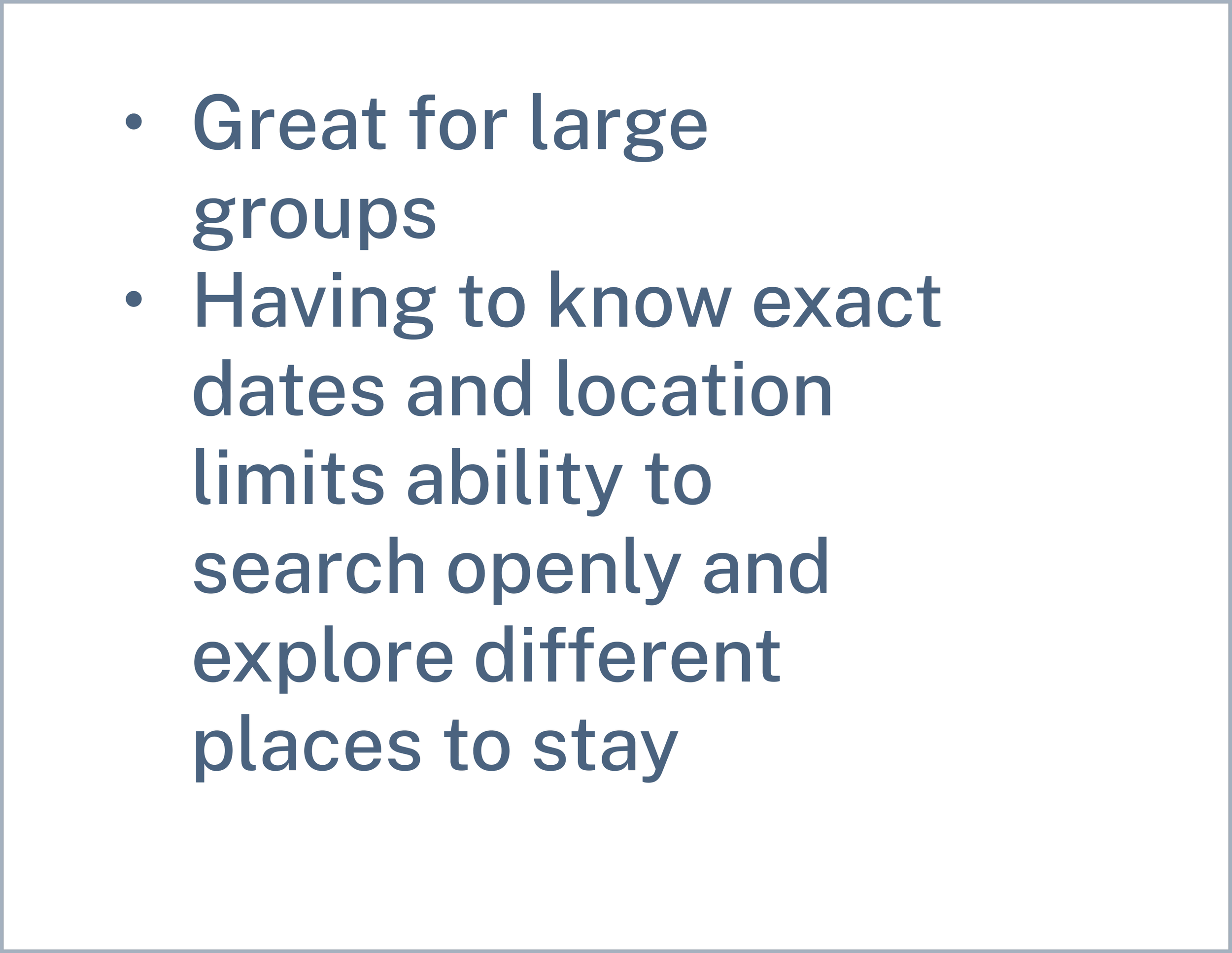
Notes
Mission Statement
Target Market
Pricing (per month)
Strengths
Weaknesses
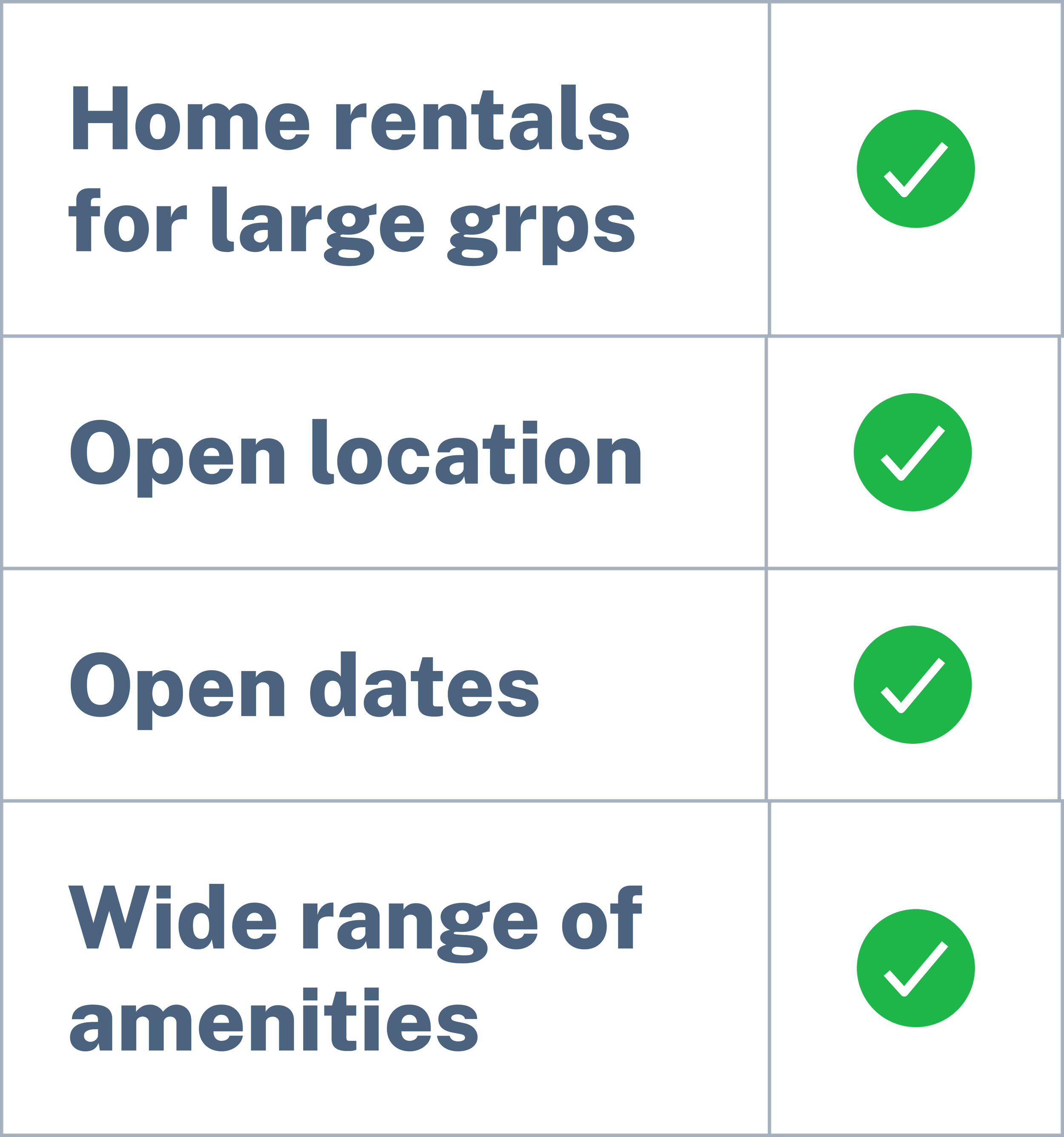
Features
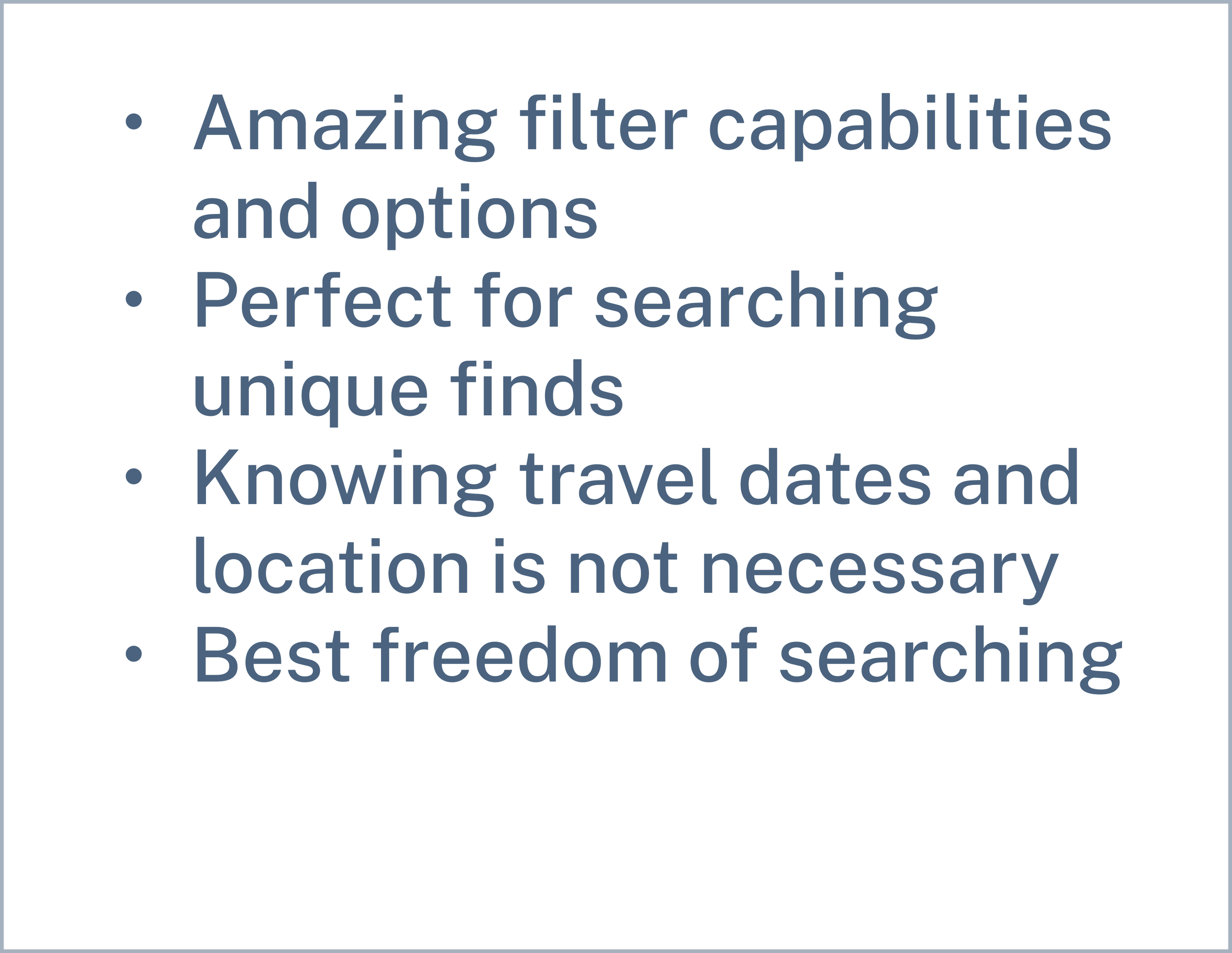
Notes

Mission Statement
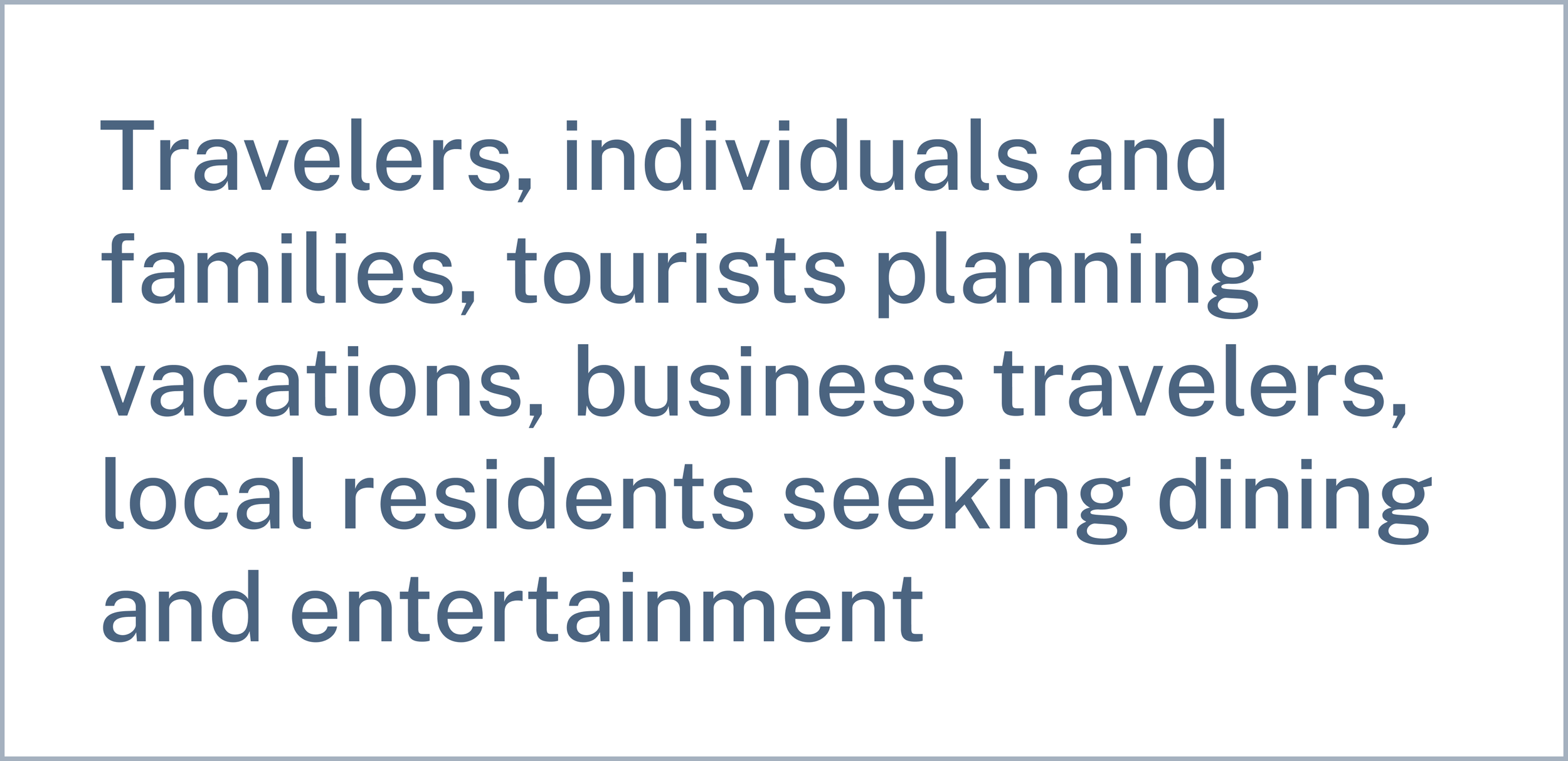
Target Market
Pricing (per month)
Strengths
Weaknesses
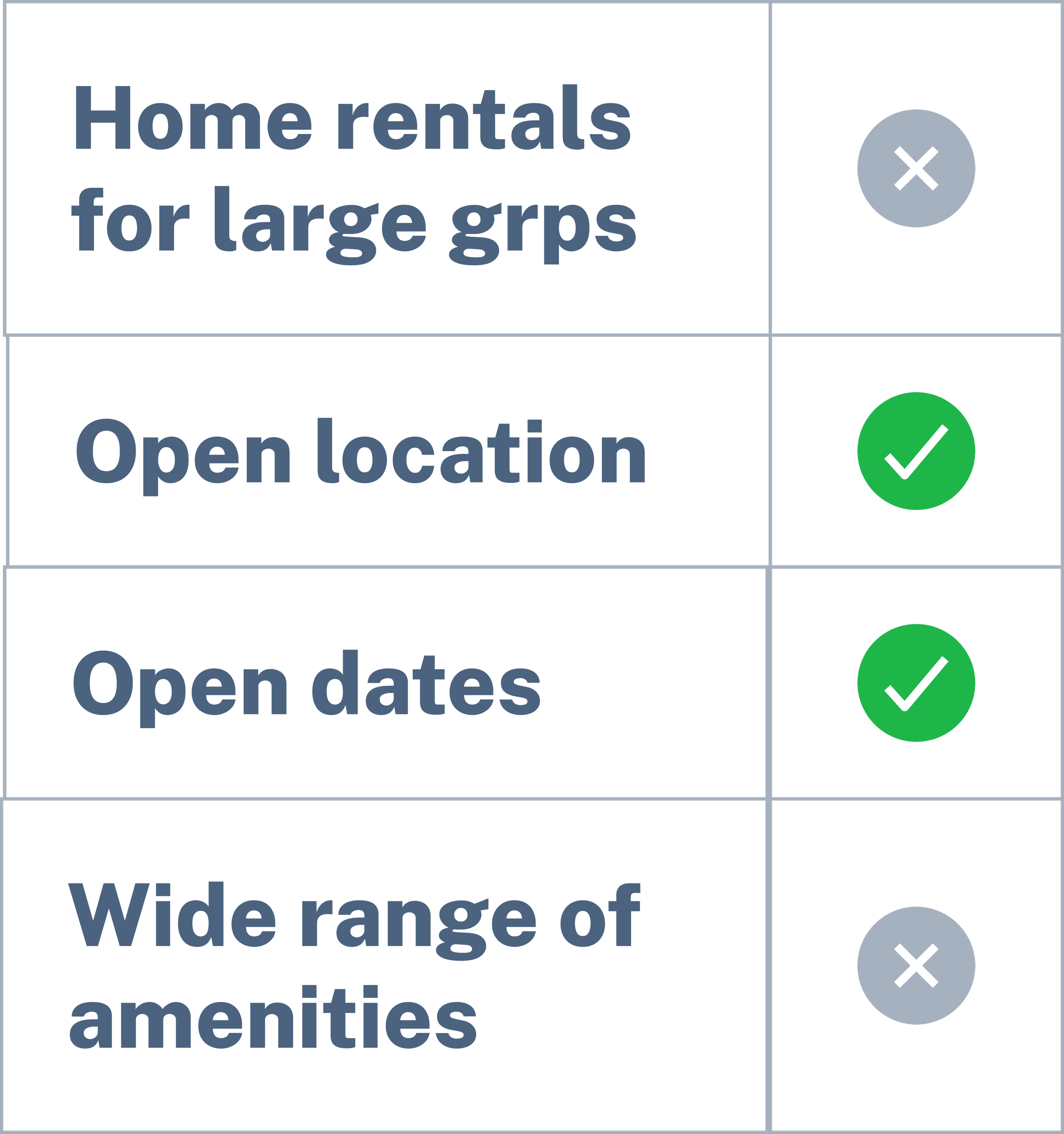
Features
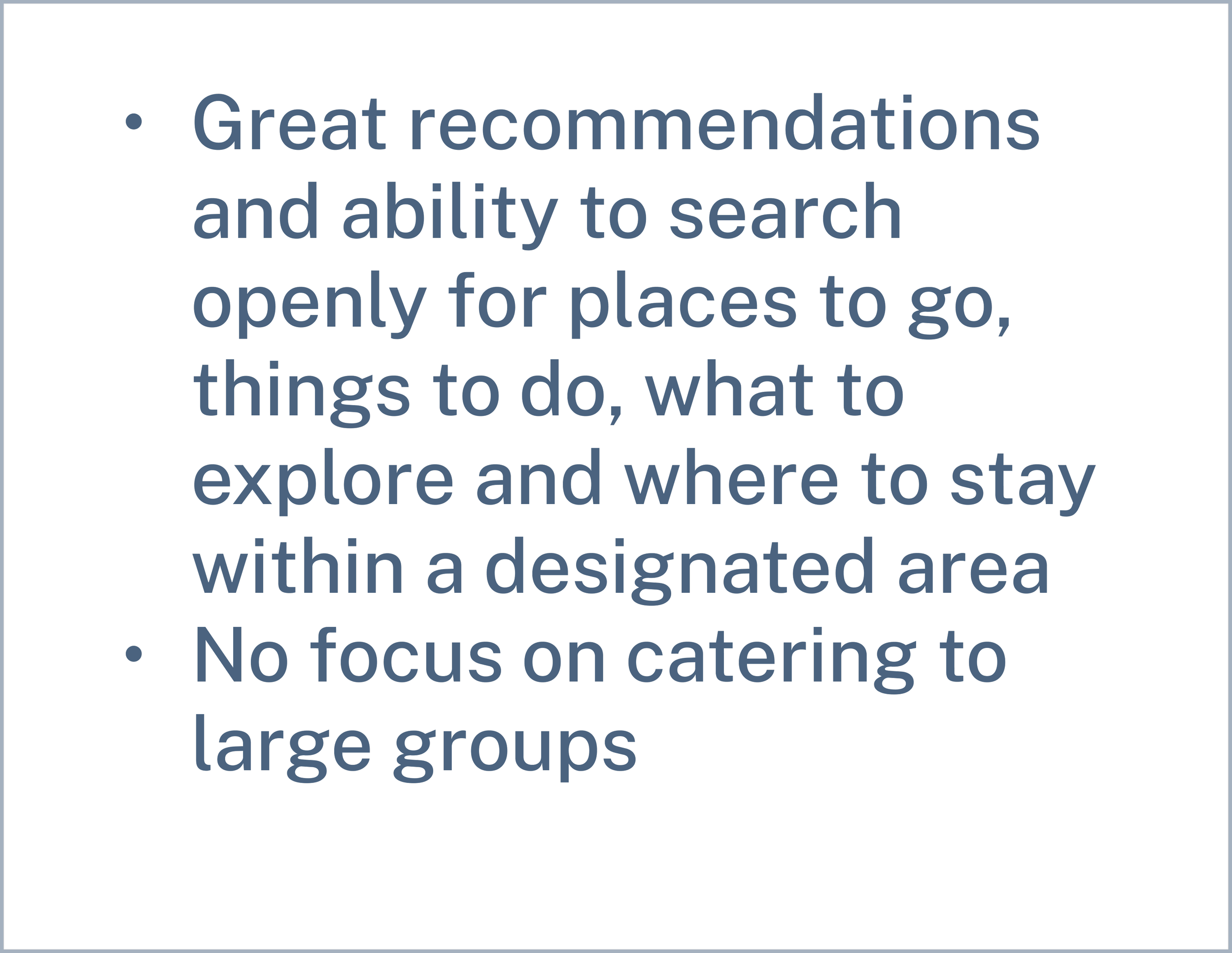
Notes


Mission Statement
Target Market

Pricing (per month)
Strengths
Weaknesses
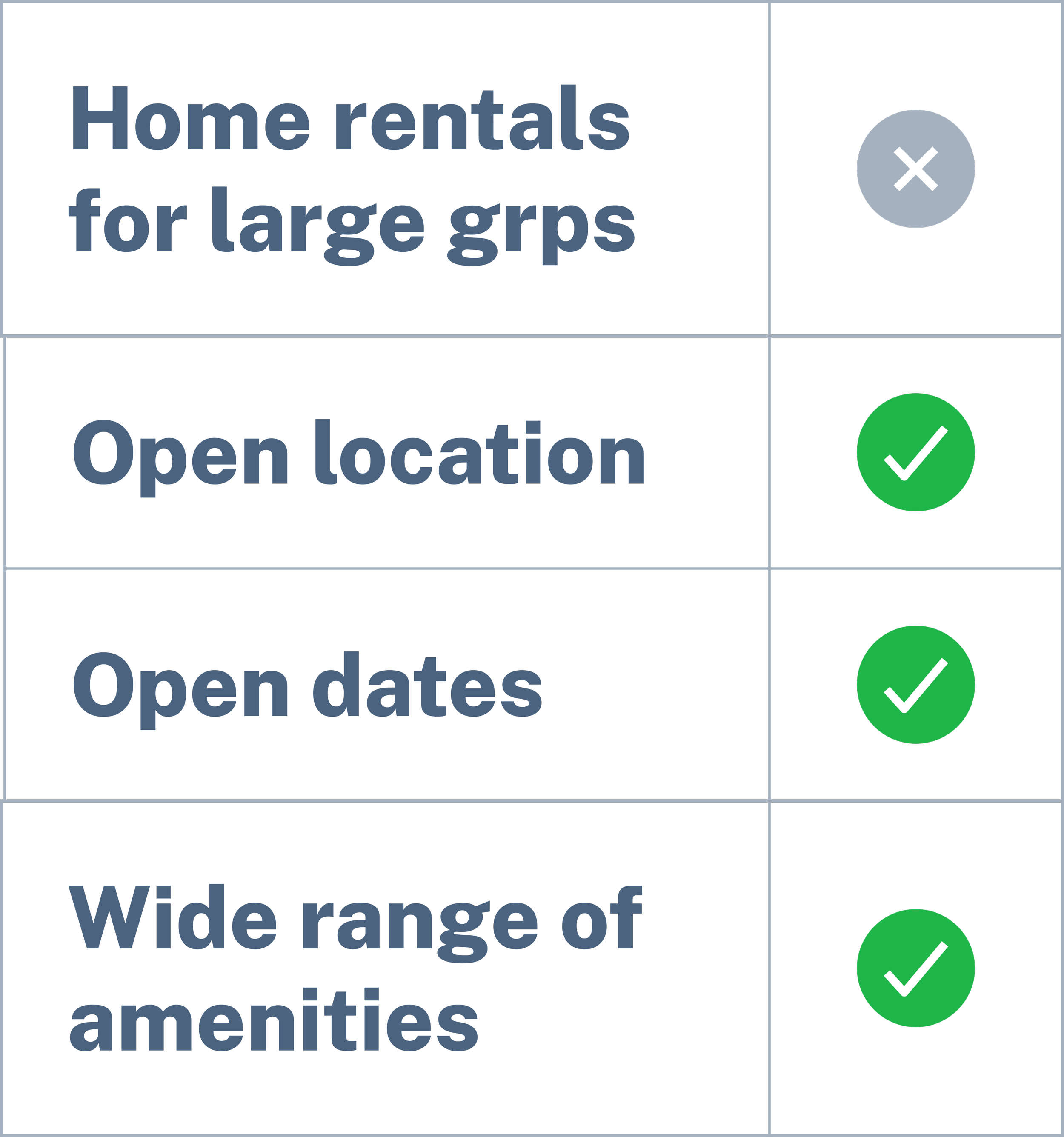
Features
Notes
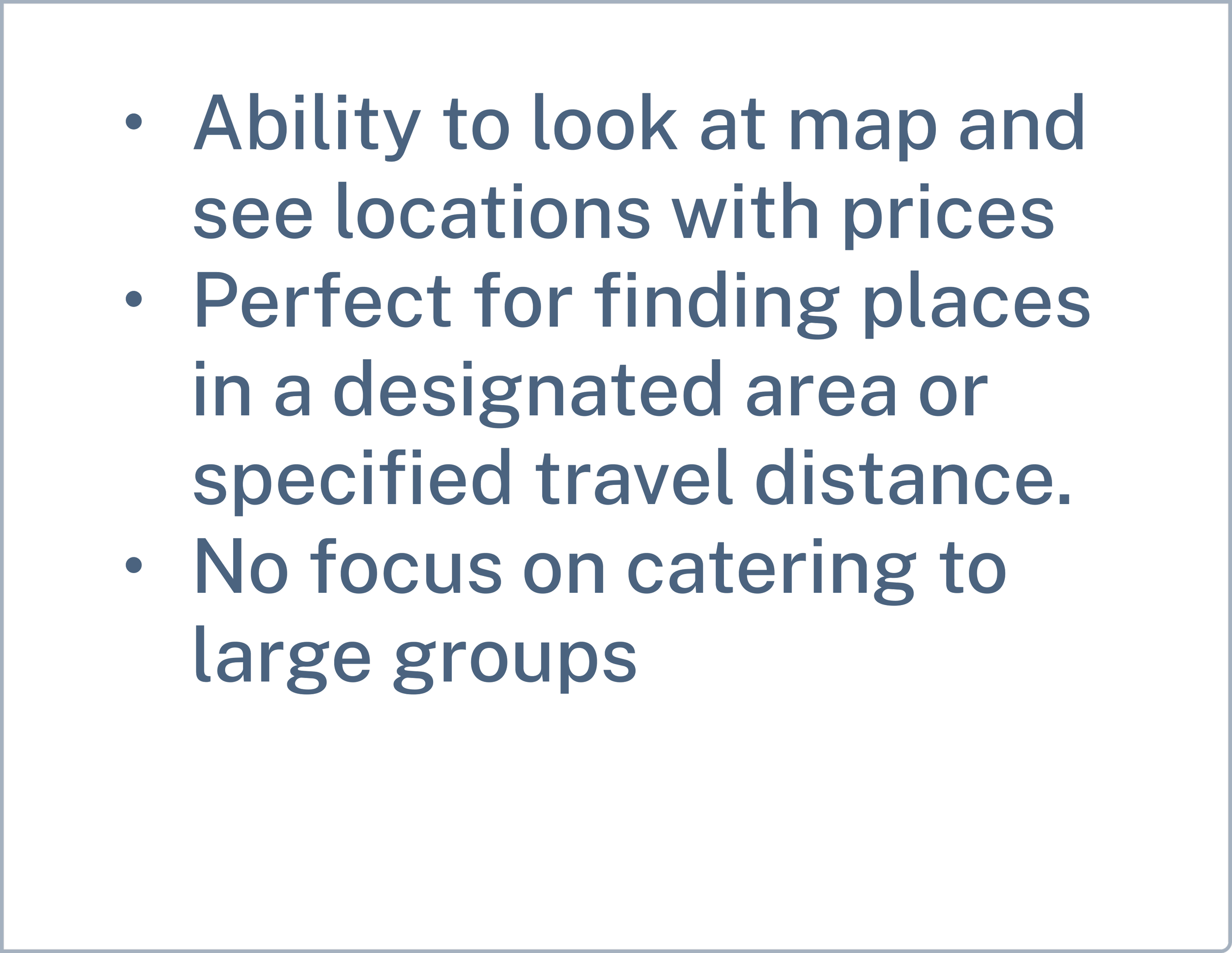
The competitive analysis reveals a strong demand for custom features that cater to different traveler needs, especially families and large groups. The vacation rental market is evolving, with travelers seeking unique and flexible accommodations. Competitors are successfully using advanced search tools and user-friendly interfaces, indicating that Vrbo needs to enhance its platform. Vrbo can improve the user experience by adding better search filters and personalized suggestions.

Interviewing a diverse range of travelers with focused questions will help gather useful insights to enhance the platform's offerings.
USER INTERVIEWS
The goal is to learn about the specific needs and preferences of users regarding vacation rentals, their pain points during the booking process, and the features they value most in an accommodation platform. Understanding their experiences and expectations will provide valuable insights to enhance offerings and improve overall user satisfaction.
Interview Questions & Answers
-
Can you describe the type of vacation you took? What was the destination, and what motivated you to choose that location?
Family vacation, Myrtle Beach
Availability
Did you travel with a large group (e.g., family, friends)? If so, how did the size of the group influence your planning and decision-making?Yes, 6 of us
The size of our group influenced it because we needed three bedrooms
How did you decide on using a specific travel website or app for your trip? What factors influenced your choice?Previous experience
I also had a referral
When did you typically use the travel website or app during your planning process? Was it before, during, or after your trip?Before and during
What specific features or search criteria did you utilize on the website or app to accommodate your group? Were there options for group bookings?We knew the location and date, we just needed it to fit our group size.
How easy was it to navigate the website or app for a large group? Were there any features that you found particularly helpful or confusing?Relatively easy
Not really, everything was self explanatory but I would like to look for places without a date in mind
Did you use the website or app to book accommodations, activities, or both for your group? How did that influence your overall travel experience?Only accommodations, not activities.
Did you want to be able to plan activities?no
What did you like most about using the travel website or app for group travel? Were there any standout features that enhanced your experience?That the app was convenient and that’s about it
What was the most important thing you looked for when trying to find a place to stay?The accommodations and the price
Did you find the user reviews and ratings helpful in making decisions for your group? How did they influence your choices?Yes, once we narrowed down our choices that we like best, we went through the reviews to make a final decision.
Were there any aspects of the app that you found frustrating or lacking?Just not having the ability to search random places without having specific dates
How satisfied were you with the accommodations or activities you booked through the website or app for your group? Did they meet your expectations?Not so much, no
Can you describe any challenges you faced while using the travel website or app for group travel? How did you resolve them?Didn’t really have any
Would you recommend the travel website or app to others planning a group trip? Why or why not?Yes because overall, I had a good experience
What improvements would you suggest for the travel website or app to better serve group travelers based on your experience?It works pretty well except that you can’t search for places without a date
Looking ahead, what features or functionalities would you like to see in travel websites or apps to enhance group travel planning?Better search filters that allow you to search for places that fit your amenities and location first and then lock down a date.
Is there anything else you would like to share about your travel planning experiences or your views on travel websites and apps, especially in relation to group travel?No
-
Can you describe the type of vacation you took? What was the destination, and what motivated you to choose that location?
A VRBO trip to Norris Lake in Tennessee with our entire family.
We grew up vacationing on lakes and we needed a place that would house 16 ppl and still be on the water.
Did you travel with a large group (e.g., family, friends)? If so, how did the size of the group influence your planning and decision-making?Yes, 16ppl
To fit that many people, we needed a big house as opposed to a normal sized house or houseboat that we have rented in the past.
How did you decide on using a specific travel website or app for your trip? What factors influenced your choice?We know from fb groups that VRBO is very good for travel down to Norris and there are several listings on VRBO for Norris Lake.
When did you typically use the travel website or app during your planning process? Was it before, during, or after your trip?Only before the trip.
What specific features or search criteria did you utilize on the website or app to accommodate your group? Were there options for group bookings?We added rough travel dates and the group size, then pulled up the map to scroll around the lake to find what we were looking for.
Did you use a map on VRBO or a different website?
We used a map on VRBO as well as a different map.
How easy was it to navigate the website or app for a large group? Were there any features that you found particularly helpful or confusing?It was pretty straight forward. Nothing that we really liked or disliked about it.
Did you use the website or app to book accommodations, activities, or both for your group? How did that influence your overall travel experience?Just the accommodations and activities didn’t influence our travel experience because where we were going, they didn’t have extra activities.
Would you have used the app for activities?It would’ve been helpful to know about the different marinas on the lake and have info about what they offer and the travel distance, but in regards to activities, there aren’t any available.
What did you like most about using the travel website or app for group travel? Were there any standout features that enhanced your experience?
A lot of pictures of the house and the surrounding area/water.
Were there any aspects of the website or app that you found frustrating or lacking when traveling with a group? How did this impact your travel planning?It would’ve been nice to search for houses on the lake and see what available dates they had as opposed to just looking for a house with specific dates. If there was a house that we liked better, then we would’ve switched our date to one that works with the property.
Did you find the user reviews and ratings helpful in making decisions for your group? How did they influence your choices?We did, it was nice to see what other ppl said about the house and know if there were any issues that would cause a problem for our group.
It wasn’t a big influence, but was something that we looked at. If we saw a pattern or any issues with a specific house, we would take it into consideration.
How satisfied were you with the accommodations or activities you booked through the website or app for your group? Did they meet your expectations?I would say satisfied.
Yes.
Can you describe any challenges you faced while using the travel website or app for group travel? How did you resolve them?Not that I can think of.
Would you recommend the travel website or app to others planning a group trip? Why or why not?Yes, it gives you the ability to see what you’re booking, see specific dates, see what’s available, move around a map to see if there’s anything else around it.
What improvements would you suggest for the travel website or app to better serve group travelers based on your experience?Searching without dates for a specific area
Looking ahead, what features or functionalities would you like to see in travel websites or apps to enhance group travel planning?Nothing that I can think of.
Is there anything else you would like to share about your travel planning experiences or your views on travel websites and apps, especially in relation to group travel?It’s nice to use FB groups and other social media to get a little bit of a different picture of what it is you’re booking or looking at to make your final decision.
-
Can you describe the type of vacation you took? What was the destination, and what motivated you to choose that location?
My friend and I went to stay at a house outside of OU
Did you travel with a large group (e.g., family, friends)? If so, how did the size of the group influence your planning and decision-making?No, just two of us
How did you decide on using a specific travel website or app for your trip? What factors influenced your choice?We thought it would be easier to use an app so we used AIRbnb
When did you typically use the travel website or app during your planning process? Was it before, during, or after your trip?Before to find and book our place
During to check the rules
What specific features or search criteria did you utilize on the website or app to accommodate your group? Were there options for group bookings?For two people
Specific date
A kitchen
washer/dryer
How easy was it to navigate the website or app for a large group? Were there any features that you found particularly helpful or confusing?It was ok.
I found it a little bit confusing due to the amount of information.
Did you use the website or app to book accommodations, activities, or both for your group? How did that influence your overall travel experience?No other activities
What did you like most about using the travel website or app for group travel? Were there any standout features that enhanced your experience?Not really
Were there any aspects of the website or app that you found frustrating or lacking when traveling with a group? How did this impact your travel planning?Places were posted on multiple sites and when we booked something, it would come back that it was already booked on a different travel app
Did you find the user reviews and ratings helpful in making decisions for your group? How did they influence your choices?We did look at reviews and it was helpful until afterwards it seemed like the reviews were biased because there were things about the place we booked that were misleading or hidden.
How satisfied were you with the accommodations or activities you booked through the website or app for your group? Did they meet your expectations?
It was fine, but I was kind of ticked because there were a few things that were misleading such as the owner of the property was there watching the entire time and there were multiple people staying in the house as well.
Can you describe any challenges you faced while using the travel website or app for group travel? How did you resolve them?I scrolled for a long time
I know better what to look for next time.
Would you recommend the travel website or app to others planning a group trip? Why or why not?Yes, but to be very careful and make sure you ask questions about
the property before booking.
What improvements would you suggest for the travel website or app to better serve group travelers based on your experience?Make an all encompassing app so you don’t have to use multiple apps to get all the info you need and better, more honest reviews that clearly describe the place.
I also felt like I was scrolling a ton to find what I wanted and what fit my budget.
Looking ahead, what features or functionalities would you like to see in travel websites or apps to enhance group travel planning?A way to know if you’re staying in a house with other people and for different apps to have better communication of rentals so that you don’t rent a property and find out later that it was already booked.
Is there anything else you would like to share about your travel planning experiences or your views on travel websites and apps, especially in relation to group travel?Maybe a filter that includes whether it’s a single dwelling place or has multiple rooms in one home.
-
Can you describe the type of vacation you took? What was the destination, and what motivated you to choose that location?
Recently went to Hilton Head
We chose it because we had never been there before and my boyfriend wanted to go there.
Did you travel with a large group (e.g., family, friends)? If so, how did the size of the group influence your planning and decision-making?No, just the two of us.
How did you decide on using a specific travel website or app for your trip? What factors influenced your choice?We’ve gone on multiple trips and have only ever used Airbnb so we didn’t think of trying a different app.
We are most comfortable with the Airbnb app because it’s really easy to use.
When did you typically use the travel website or app during your planning process? Was it before, during, or after your trip?All of the above.
We used it before to plan the trip, during to communicate with the host for information regarding the property (ie: key, wifi password), and after to rate our stay.
What specific features or search criteria did you utilize on the website or app to accommodate your group? Were there options for group bookings?We looked for properties with a pool and gated community
We didn’t need group options
How easy was it to navigate the website or app for a large group? Were there any features that you found particularly helpful or confusing?I think it’s very easy to use because it’s very simple and plain text. I like that you can see the entire cost with all of the fees. You just click on fees and it breaks it down for you.
Did you use the website or app to book accommodations, activities, or both for your group? How did that influence your overall travel experience?Just accommodations, no activities. But we did look to see where activities were in location to the property. When we went to Disney, we wanted to stay close to the park so we made sure we were staying close.
What did you like most about using the travel website or app for group travel? Were there any standout features that enhanced your experience?The convenience of it and it was easy to use and understand. I liked that you can see the total price before and after taxes and fees.
Were there any aspects of the website or app that you found frustrating or lacking when traveling with a group? How did this impact your travel planning?No, nothing
Did you find the user reviews and ratings helpful in making decisions for your group? How did they influence your choices?Yes.
I only book places with excellent reviews.
How satisfied were you with the accommodations or activities you booked through the website or app for your group? Did they meet your expectations?I’ve been happy with every place we’ve stayed so far.
Everything met our expectations.
Can you describe any challenges you faced while using the travel website or app for group travel? How did you resolve them?I didn’t experience any problems
Would you recommend the travel website or app to others planning a group trip? Why or why not?Yes of course
What improvements would you suggest for the travel website or app to better serve group travelers based on your experience?
I can’t think of anything
Is there anything else you would like to share about your travel planning experiences or your views on travel websites and apps, especially in relation to group travel?I’ve had great experiences so far. I don’t always have a place in mind to stay and our dates are flexible so sometimes I just look for ideas and then I can save places I like to a board in the AIRbnb app.
-
Can you describe the type of vacation you took? What was the destination, and what motivated you to choose that location?
Nashville, TN
Because it was the halfway point between my friend and I
Did you travel with a large group (e.g., family, friends)? If so, how did the size of the group influence your planning and decision-making?Just two of us
It didn’t
How did you decide on using a specific travel website or app for your trip? What factors influenced your choice?Because I was booking it last minute, I chose to use Expedia to get the best and lowest price.
When did you typically use the travel website or app during your planning process? Was it before, during, or after your trip?Before to book it and during to make changes
What specific features or search criteria did you utilize on the website or app to accommodate your group? Were there options for group bookings?I wanted to know if there was free parking because parking in Nashville is expensive. Some hotels are valet only and that can be expensive too. I also wanted a pool.
How easy was it to navigate the website or app for a large group? Were there any features that you found particularly helpful or confusing?Yes, it was easy but…If I navigated away from the app, the price would raise because it was tracking my search history.
Did you use the website or app to book accommodations, activities, or both for your group? How did that influence your overall travel experience?Just accommodations– It didn’t influence anything because I don’t book activities through the travel app. I use the website to book the specific activity.
What did you like most about using the travel website or app for group travel? Were there any standout features that enhanced your experience?Feeling like I got a good deal
Were there any aspects of the website or app that you found frustrating or lacking when traveling with a group? How did this impact your travel planning?Not really
Did you find the user reviews and ratings helpful in making decisions for your group? How did they influence your choices?Yes, I based my decision on the reviews
How satisfied were you with the accommodations or activities you booked through the website or app for your group? Did they meet your expectations?I liked where we stayed but there was construction going on outside and the jack hammering was loud and annoying. The pipes were also loud because it was an old building
Can you describe any challenges you faced while using the travel website or app for group travel? How did you resolve them?Not really, there weren’t any except for navigating away from the app.
Would you recommend the travel website or app to others planning a group trip? Why or why not?Yes
Looking ahead, what features or functionalities would you like to see in travel websites or apps to enhance group travel planning?
The ability to change your room type when you’re at the hotel because the hotel won’t let you change it once you’re there because it was booked through a third party.
Is there anything else you would like to share about your travel planning experiences or your views on travel websites and apps, especially in relation to group travel?
Just that it really helps to check different apps to get the best prices.
Given the abundance of valuable insights from user responses, the content has been refined for clarity. Below is a summary of the top findings based on the experiences of five users across different travel platforms:
Travel Type and Group Size:
Users traveling with larger groups (like Chris and Brian) prioritized accommodations that could fit their needs, while smaller groups (like Parker and Ally) had simpler planning requirements.
Platform Selection:
Choice of travel platform was influenced by past experiences and recommendations; VRBO was preferred for extensive listings, while Airbnb was noted for user-friendliness.
Navigation and User Experience:
Overall, apps were considered easy to navigate, but users expressed a desire for better filtering options and the ability to search without specifying travel dates.
Booking Preferences:
Users primarily booked accommodations and showed minimal interest in planning activities through the apps, preferring alternative resources for that purpose.
User Reviews:
Reviews were crucial in decision-making, though some users noted concerns about biases in the reviews.
Satisfaction Levels:
User satisfaction varied, with some users content with their accommodations while others experienced issues like misleading property descriptions.
Challenges and Recommendations:
Common challenges included navigating multiple listings and inflexible search options. Users suggested enhancements like clearer property descriptions and improved communication between platforms.
Desired Future Features:
Users expressed a desire for better filtering options, clearer communication about shared accommodations, and the ability to modify bookings easily.

Moving forward, the next step involves examining these responses in an affinity map. This approach will help categorize and visualize the insights, allowing for a more in-depth understanding of user needs and preferences, ultimately guiding enhancements to the travel experience.
AFFINITY MAP
To create the affinity map, a systematic approach was used to organize insights from user responses. Key themes and patterns were identified, focusing on recurring topics and sentiments.
Responses were reviewed and categorized into groups based on similarities, such as accommodation preferences and user experiences. This visual arrangement provides a clear representation of insights, helping to identify trends and relationships among user experiences. This method aids in understanding user needs and serves as a foundation for targeted improvements in the travel experience.
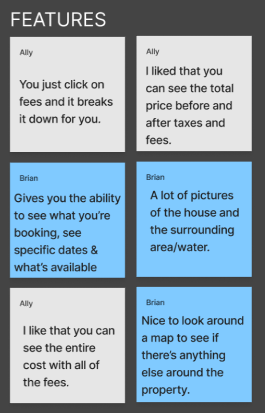
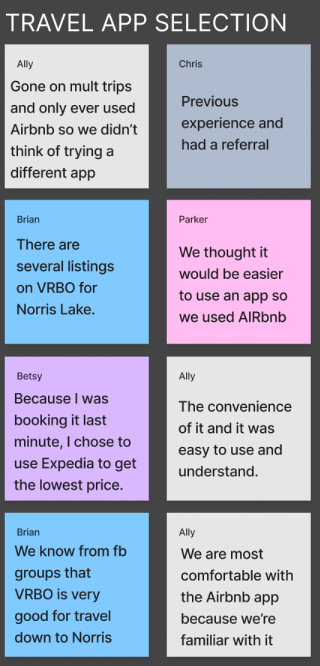
Key insights from the affinity map include:
1. Accommodation Preferences: Users prioritize space, amenities, and location when selecting accommodations.
2. User Experience: A seamless and intuitive interface is crucial for a positive user experience.
3. Review Impact: User reviews significantly influence decision-making and trust in platforms.
4. Search Functionality: Users desire improved search options to narrow down choices effectively.
5. Communication Gaps: There are concerns regarding communication between platforms and users, highlighting the need for better support.

These insights provide a comprehensive understanding of user needs and expectations within the travel experience. The next task on the agenda is to develop detailed user personas that accurately represent our target audience.
PERSONAS
To support future design decisions, three personas were developed to embody and recognize distinct user types, which is essential for several reasons:
Understanding User Needs
Alignment Across Teams
Empathy Building
Targeted Solutions
Informed Decision-Making
By analyzing these personas, identifying common pain points allows for tailoring offerings to specific audience segments, ultimately enhancing user satisfaction and engagement. This approach helps in understanding what users need and want, making it easier to create better solutions and understand the goals of the business.
"Strong personas are the bridge between understanding our users and crafting solutions that truly resonate."

Having defined user pain points and needs, creating a Venn diagram will visually show the overlap between user needs, business goals, and potential solutions.

PROJECT GOALS
Research findings highlight areas of alignment from a Venn diagram, identifying opportunities for improvement. Strategies should address both user desires and business objectives to ensure success.
Business Goals:
Increase sales through bookings and partnerships.
Expand the user base by targeting new demographics.
Enhance brand visibility and reputation in the travel sector.
Improve user retention via enhanced experiences and loyalty programs.
User Goals:
Easily search and book travel accommodations and activities.
Obtain personalized travel recommendations based on user preferences.
Identify deals and budget-friendly options.
Access comprehensive information about travel destinations.
Connect with other travelers through reviews and social features.
Technical Goals:
Ensure the platform can manage a growing number of users and transactions.
Implement robust security measures to protect user data.
Optimize loading times and enhance performance.
Facilitate seamless integration with third-party services.
Develop an intuitive interface for users with varying technical skills.

This understanding enables the development of targeted solutions that address specific challenges while aligning with both user needs and business goals. Recognizing user pain points and business objectives is crucial for formulating effective problem statements for the next task.
PROBLEM STATEMENTS
By effectively applying the research, problem statements and "how might we" questions to better understand user frustrations.
Travelers often struggle to find accommodations that meet their specific needs and preferences due to a lack of essential features and clear information during the booking process. This can lead to frustration, uncertainty, and a suboptimal travel experience.
How might we enhance our accommodation search platform by integrating comprehensive filtering options that allow travelers to easily specify their desired location, price range, amenities, and room types, ensuring they can quickly find suitable options that meet their criteria?
How might we implement a user-friendly interface that prominently displays important information such as user reviews, cleanliness ratings, cancellation policies, and customer service contact details, empowering travelers to make informed decisions when booking accommodations?
Users often face challenges when searching for travel accommodations and activities due to limited search criteria, which can lead to frustration and missed opportunities for finding the best options.
How might we provide a broader range of search filters, allowing users to refine their results based on as many or as few specific preferences, such as price range, amenities, location, and user ratings, leading to a more satisfying and relevant experience?
How might we enable users to find exactly what they are looking for by offering more comprehensive search options that can reduce decision fatigue, increase the likelihood of completing a booking, and benefit the platform's conversion rates?
Users struggle to find travel options that match their unique preferences and interests due to generic recommendations.
How might we utilize advanced algorithms and machine learning to analyze user behavior and preferences, allowing us to provide tailored travel suggestions and personalized itineraries that enhance user satisfaction?
How might we create an interactive user profile system that gathers input on travelers' interests, past trips, and preferred activities, enabling us to deliver customized travel recommendations and experiences that resonate with their individual tastes and enhance their overall journey?

In conclusion, the discovery of these problem statements has provided valuable insights into user frustrations and needs. By clearly articulating these challenges, the focus can now shift to developing a comprehensive feature set that addresses these issues.
FEATURE SET
The focus will be on the top three features, prioritized for their significant impact on user satisfaction and business goals. They provide essential solutions that foster personalization, improve usability, and drive engagement, directly addressing key pain points to create a more intuitive platform.
1. Personalized Recommendation Engine
- Utilize algorithms to analyze user behavior, preferences, and past bookings. This feature will provide tailored travel options that align with individual user interests, enhancing satisfaction and engagement.
- High priority, due to the identified need for personalization, which can significantly improve user retention.
2. Advanced Search Filters
- Allow users to filter options based on criteria such as price range, amenities, location, travel style, and user ratings, without requiring a combination of these.
- Comprehensive filters help users refine their search, making it easier to find relevant options.
- High priority, as users have expressed frustration with generic recommendations and the need for more control over their searches.
3. Mobile Optimization
- Ensure the platform is fully optimized for mobile devices, including responsive design and easy navigation.
- Users can easily access the platform from various devices for travel planning, seamless mobile experiences are crucial.
- High priority due to the growing trend of mobile usage in travel planning.
Additional features that could be make a valuable difference in the website but are not being focused on at this time:
4. Interactive User Profiles
5. User Reviews and Ratings Display
6. Dynamic Itinerary Builder
7. Real-Time Availability and Pricing Updates
8. Loyalty and Rewards Program
9. Chat Support and FAQs
10. Multilingual Support
In conclusion, the feature set outlined above is strategically designed to address user needs and enhance overall satisfaction. By prioritizing the top three features—Personalized Recommendation Engine, Advanced Search Filters, and Mobile Optimization—this approach effectively fosters personalization, improves usability, and drives engagement.

Utilizing the insights gathered, a user flow will be developed to clearly demonstrate how these features meet user needs, providing a seamless and intuitive experience that aligns with both user expectations and business objectives.
USER FLOW
The user task flow is vital as it outlines the steps users take to reach their goals. Mapping this flow identifies pain points and optimizes the experience, ensuring interactions are intuitive. This clarity boosts user satisfaction and supports business objectives by expanding the “where to” filter, providing greater flexibility in selections and ultimately offering more options for places to stay.

Developing the task flow was crucial for creating low-fidelity wireframes, as it outlined user interactions and pathways. This clarity helped ensure the wireframes were designed to enhance user experience and streamline navigation.
LOW FIDELITY WIREFRAMES
Creating low-fidelity wireframes is crucial for visualizing ideas and establishing structure before adding details. By focusing on layout and functionality, concepts can be easily iterated. These designs will provide a baseline for high-fidelity wireframing and prototyping.

With the current design, logo, and brand already established for Vrbo, moving straight into crafting high-fidelity wireframes will bring the vision to life.
HIGH FIDELITY WIREFRAMES
The high-fidelity wireframe designs incorporate insights from research and user feedback, ensuring they meet user needs and project goals while providing a visually engaging and functional experience. Before revealing the newly designed wireframes, screenshots of side-by-side comparisons illustrate the current Vrbo designs alongside the new search features, highlighting improved search filters.
The current website design requires users to select “where to” first. While dates can be flexible, this approach restricts users from searching based on various criteria. This limitation reduces the number of available properties that could be discovered if the focus were on amenities and dates instead of immediately choosing a location.
Actual Vrbo screens:
New search Vrbo screens:
Wireframes before testing

Developing a usability test plan for the wireframes will help assess their effectiveness, identify usability issues, and gather feedback from users. This process ensures that the designs meet user needs and enhance overall user experience.
USABILITY TEST PLAN
To evaluate the overall effectiveness of the design and its ease of use, a usability test plan was devised to ensure that the right questions were asked, facilitating the collection of useful and informative feedback from users.

Following the testing of the prototype by each participant, insightful feedback and recommendations were collected. This information required organization and summarization of the test results, aiding in the effective planning of essential modifications.
USABILITY TEST RESULTS
Prioritizing test results ensures that critical feedback is addressed first, leading to effective design improvements and a better user experience.

Key Takeaways:
The testing revealed that all participants understood the new feature and agreed that less specific search criteria will enhance vacation planning. While tasks were completed successfully, some hesitation was noted during selections. Suggested adjustments include modifying field and text colors and removing the bottom search bar to improve user experience. Further testing will evaluate the effectiveness of these changes.

A visual representation of iterations will clarify the design process, showcase changes based on feedback, and illustrate the evolution from initial concepts to final adjustments
ITERATIONS
In response to user feedback, the following modifications have been implemented across the screens. The objective of these modifications is to improve usability and elevate the overall user experience.

With changes in place, high-fidelity wireframes and prototypes can be developed to provide a detailed and realistic representation of the final product, facilitating user testing and feedback for further refinement.
HIGH FIDELITY PROTOTYPE
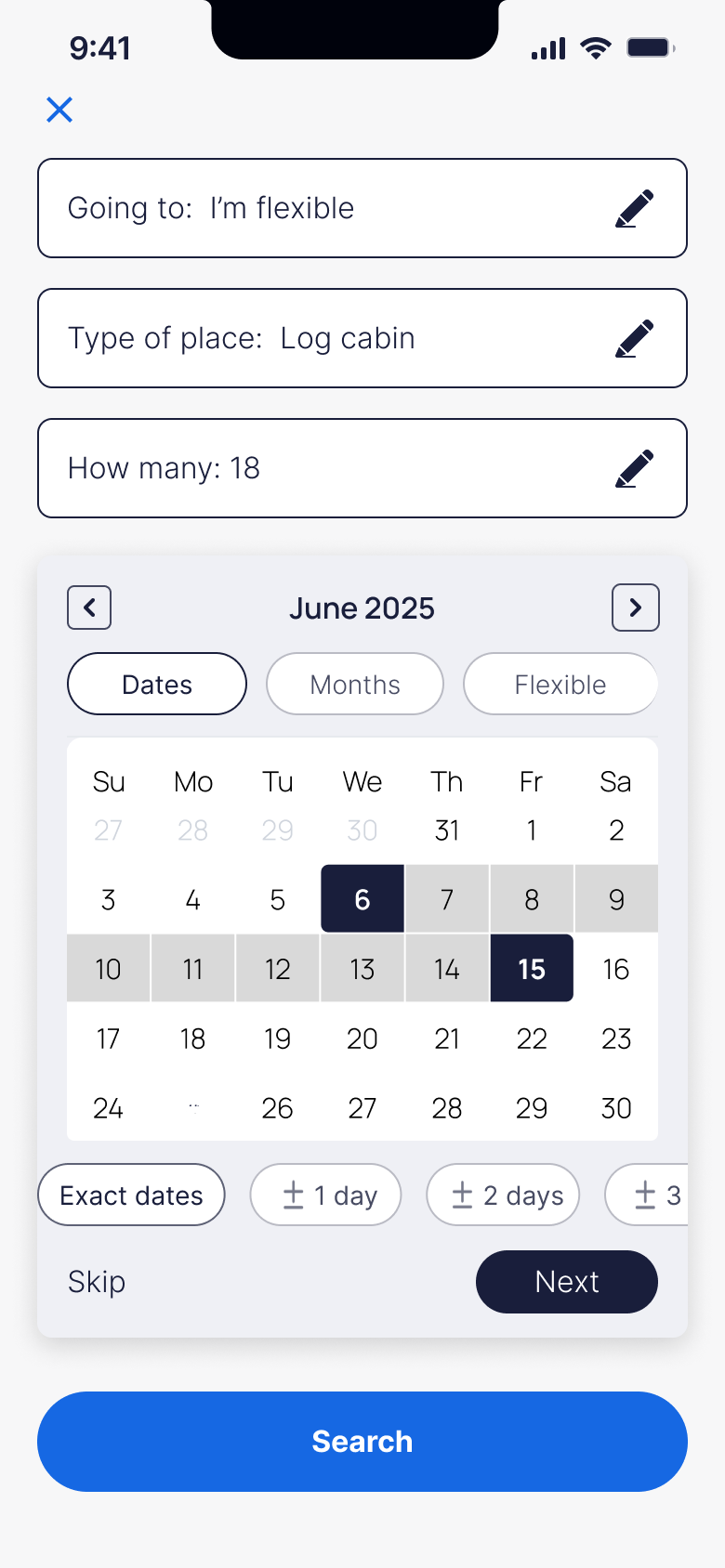
The final revisions and development have effectively refined the Vrbo design, incorporating all user feedback. Users can now search for properties without needing precise knowledge of their destination, allowing for a broader selection tailored to their group size, desired amenities, or specific dates. This comprehensive approach has culminated in a polished product that meets user needs and enhances the overall experience, setting the stage for a successful launch.
To test the prototype, use the following task:
A user visiting the app for a first time that is flexible in location and wants a log cabin for the dates June 6-15.

REFLECTION
Insights derived from the research provide key highlights for enhancing the VRBO platform. User interviews revealed the importance of understanding specific needs, as travelers often struggle with rigid search criteria, necessitating more flexible filtering options for group dynamics, such as varying sizes and desired amenities. Introducing personalized recommendation features and advanced search filters is crucial, as users seek tailored experiences that align with their travel goals, increasing satisfaction and engagement. Current limitations in search functionality frustrate users, highlighting the need for options that allow searching without specific dates or by prioritizing amenities. Mixed satisfaction levels indicate challenges like misleading property descriptions and the need for clearer communication about amenities, which can be improved through better transparency and user reviews. Moving forward, there is an opportunity to implement features that enhance user experience and position VRBO competitively, including mobile optimization, improved support, and a loyalty program. Overall, the project emphasizes the necessity of aligning design solutions with user needs to create a more personalized and efficient travel planning experience, ensuring Vrbo remains a leader in the vacation rental market.